Home / Blog / Radial Run-Out and Balance
PROCESS GUIDERadial Run-Out and Balance: The Uniformity Check Every Retread Needs Before It Ships
Buffing can throw a perfectly round casing out of round. Here's how radial run-out and force variation actually work, why retreaders check balance after cure, and what it means for ride quality.
Published September 18, 2026 · Good Hope Retreaders
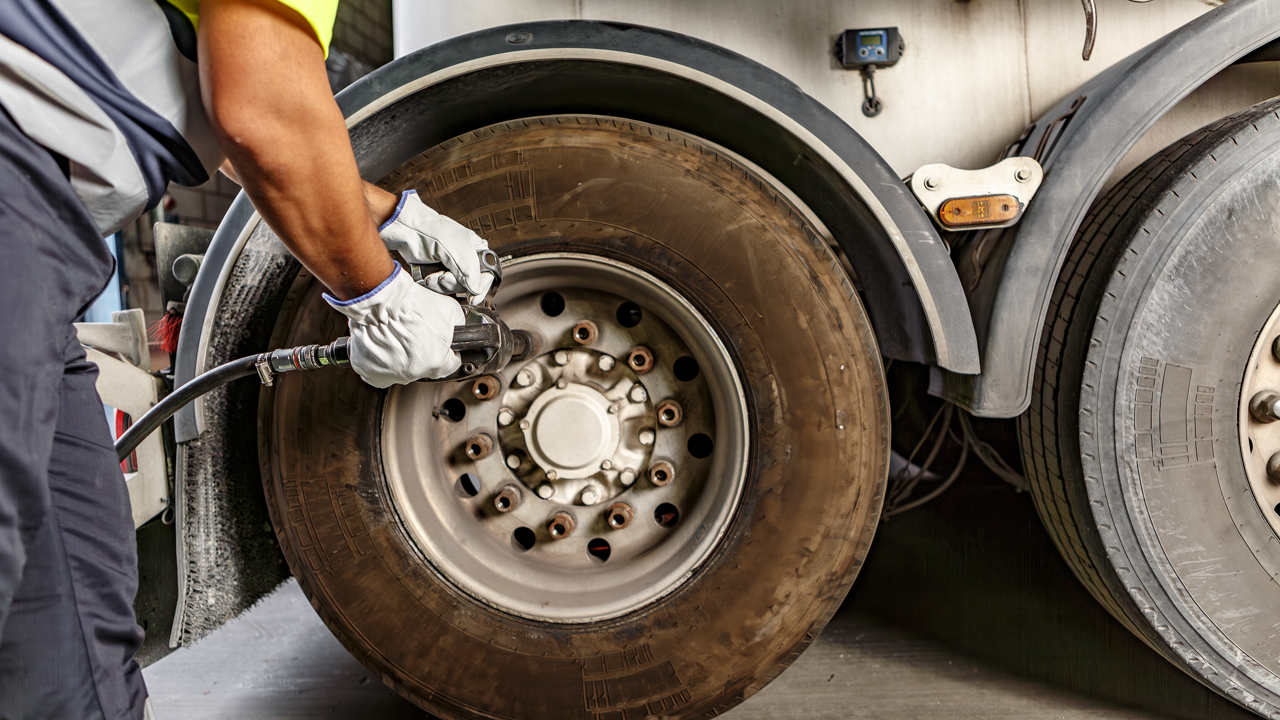
Most conversations about retread quality focus on the bond — did the tread stick, did the cure hold, is the casing sound. All of that matters. But a retread can be perfectly bonded and still ride badly, and the reason usually traces back to a step that gets a lot less attention: whether the finished tire is actually round.
Buffing removes the old tread down to the casing, and that process itself can introduce the very unevenness a good retread is supposed to fix. Here's what radial run-out and force variation actually are, why they happen, and how the retreading process checks for them before a tire goes back on a truck.
Buffing can make a round tire less round
A worn casing rarely wears down perfectly evenly — first-life tread wear, prior repairs, and the casing's own construction variance all leave a surface that isn't a true circle. When the buffer removes that old tread to prepare the casing for new rubber, it's cutting to a target radius, but the casing underneath it can still carry small high and low spots — what the industry calls radial run-out, or out-of-roundness. Buffing to remove worn tread can create or expose these radial non-uniformities even on a casing that looked fine going in.
Retreaders account for this by measuring the buffed casing for run-out and indexing the high and low points — then applying the cushion gum and new tread in a way that compensates for those variations rather than locking them in. Some shops use computer-controlled radial buffing systems, guided by a casing specification database and continuous undertread measurement, specifically to hold that undertread depth even across the crown as the casing spins — because an uneven cut is one of the more common ways run-out gets built into a finished retread.
Run-out, force variation, and balance aren't the same thing
These terms get used loosely, but they describe distinct properties, and it's worth knowing the difference:
- Radial run-out is a geometric measurement — how much the tire's radius varies as it rotates. It's about shape.
- Radial force variation (RFV) is the amount of stiffness variation the tire produces over one revolution under a constant load — driven by both run-out and by variation in the tire's internal stiffness, not shape alone. High RFV puts vertical force disturbances into the vehicle even when the tire looks round.
- Static and dynamic balance — the kind a wheel balancer checks at tire mounting — is about mass distribution, not shape or stiffness. A tire can be perfectly balanced and still have high RFV, which is exactly why a balancer alone doesn't catch every uniformity problem. RFV issues can cause a vibration a standard wheel balance won't reveal.
RFV measurement isn't new — it's been used in the tire industry since the 1970s, and OEM low-speed RFV testing is defined by SAE Practice J332. The reason it still matters at the retread stage is straightforward: the buffing and rebuilding process is a second opportunity to introduce the kind of stiffness and shape variation that RFV measures, on a casing that may have already been through one life of wear.
Why it matters to a fleet
A tire with significant run-out or high RFV doesn't fail — it rides badly. Drivers report a vibration, often blamed first on an alignment issue or a worn suspension component, that turns out to trace back to a single tire. Beyond driver comfort and complaint calls, uneven force distribution around the tire's circumference tends to produce uneven wear, which shortens the useful life of the very casing a retread program is trying to extend. Catching a uniformity problem before the tire leaves the shop is cheaper than diagnosing a phantom vibration complaint on a truck weeks later.
How retreaders check for it
A finished retread doesn't just get inspected for its bond and casing integrity — the tire is put through a second round of non-destructive testing and a balance check after cure, specifically to confirm that the remolding process itself didn't introduce a new defect or throw the tire's balance off from where it was measured going in. That post-cure check is what catches a run-out or balance problem that the buffing and building stages didn't fully compensate for.
At the higher end of the industry, plants use dedicated tire uniformity graders and optimizers — equipment built specifically to measure RFV and either flag a tire for correction or grind a controlled amount of tread to bring the force variation back within spec. That level of equipment is standard at large-scale, high-volume plants. For an independent or mid-size shop, it's not the realistic tool — the combination that actually prevents most uniformity problems at that scale is a well-maintained buffer held to a consistent undertread target, careful indexing of high and low spots during tread application, and a standard wheel balance once the finished tire is mounted. That won't catch every RFV case a uniformity grader would, but it catches the run-out and mass-imbalance problems that account for most of what a driver actually feels.
Where it starts: a consistent buffing radius
Uniformity problems and bond-quality problems trace back to the same step for a reason — buffing to a correct, even radius. Undertread is commonly targeted in roughly the 3/32"–5/32" range: enough rubber left over the belt package to avoid exposing steel, but not so much that it holds excess heat in normal operation. Buffing to that target unevenly — leaving more material on one side of the casing than the other — is one of the more direct ways a shop introduces both a bond-quality risk and a run-out problem in the same pass. It's why buffer calibration and technician attention at this stage do double duty: get the radius even, and ride quality and bond quality both benefit.
For more on that side of the process, see our guide to buffing and rasping for bond quality, and the 5-point casing inspection that should happen before a casing ever reaches the buffer.
RELATED GUIDES
Equipping your line for consistent buffing
Uniformity starts with a buffer that holds its radius and a technician who knows how to read a casing's high and low spots — not a capital purchase most independent shops need to make on day one. We supply buffing machines, rasp blades, and the rest of the core retread line with transparent all-in Canadian pricing and delivery from our Ontario warehouse. Tell us your tire sizes and volume and we'll spec the right setup for your shop.
Get an equipment quote →Ask About Buffing & Retread Line Equipment
Send us your requirements and we'll get back to you within 24 hours with pricing and lead times — no obligation.