Home / Blog / Pre-Cure vs. Mold-Cure Retreading
PROCESS GUIDEPre-Cure vs. Mold-Cure Retreading: Which Process Fits Your Shop
An honest comparison of pre-cure and mold-cure retreading — capital cost, tread pattern flexibility, and which process fits an independent or mid-size shop.
Published August 17, 2026 · Good Hope Retreaders
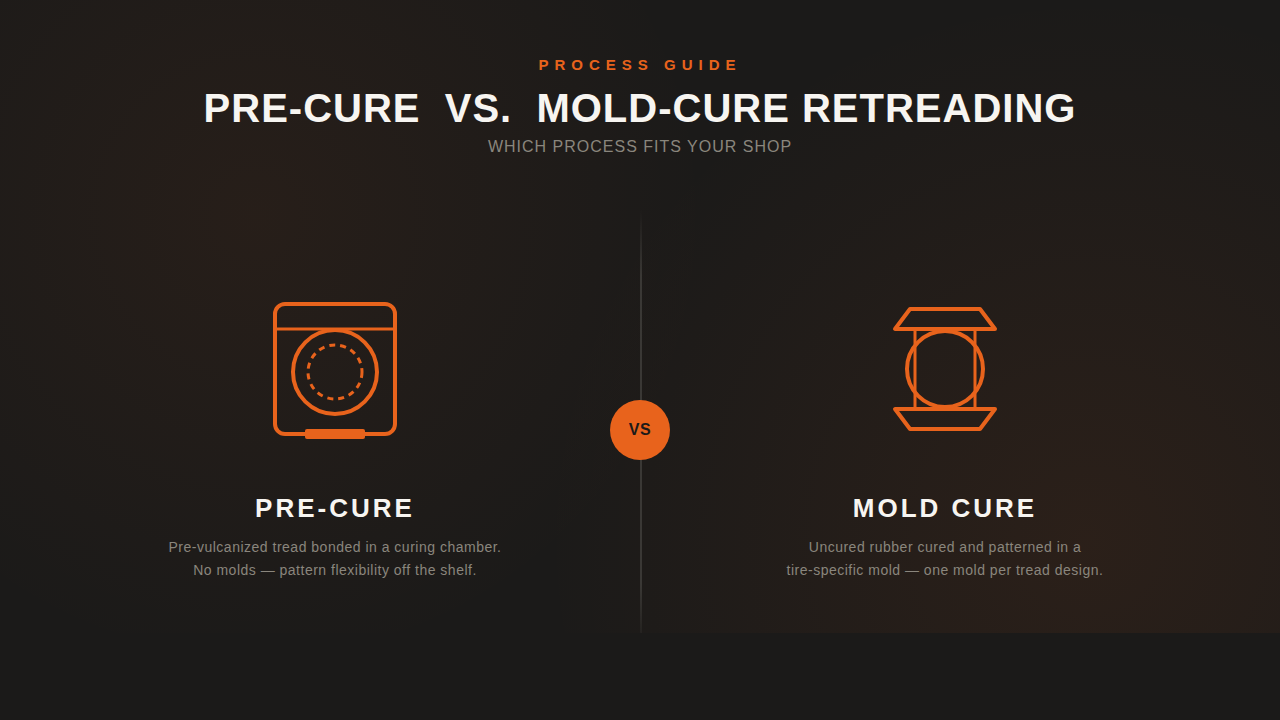
Every retread starts the same way — inspect the casing, buff it down, prep the surface. Where the two processes split is how the new tread goes on and cures. Pre-cure bonds an already-vulcanized tread strip to the casing in a curing chamber. Mold cure lays down uncured rubber and vulcanizes it, tread pattern and all, inside a tire-specific mold. TRIB (the Tire Retread & Repair Information Bureau) is direct about why both still exist: it's a question of plant economics, not tire quality — both processes, done correctly, produce an equally good retread.
This guide breaks down what actually separates them so you can pick the process that fits your shop, not just the one you've heard of.
What each process actually is
Pre-cure (cold process)
A thin layer of cushion gum goes onto the buffed casing, and a strip of pre-cured tread rubber — already vulcanized, with the tread pattern already molded in — is applied over it. The assembly is wrapped in a curing envelope and cured in a curing chamber at a relatively low temperature, roughly 95–115°C. The chamber's job is only to vulcanize the cushion gum bond layer; the tread itself is already finished.
Mold cure (hot process)
Uncured camelback tread rubber is applied to the buffed casing, and the whole tire goes into a mold that carries the tread pattern. Heat and pressure inside the mold vulcanize the rubber and stamp in the tread pattern at the same time — the same basic mechanism new-tire manufacturers use.
Where pre-cure wins
- Lower capital cost to start and to scale. Mold cure needs a dedicated mold for every tire size and tread pattern combination you run, and that mold library has to be maintained and periodically updated as patterns change. Pre-cure shifts that cost to the tread rubber manufacturer — your shop needs a curing chamber, not a mold room.
- Tread pattern flexibility, off the shelf. Because the tread is pre-molded by the rubber supplier, a pre-cure shop can stock or order multiple tread designs and switch between them without buying new tooling. Mold cure ties every pattern to its own mold.
- It's what most independent and commercial-truck shops already run. Market-research estimates differ on the exact split — Fortune Business Insights puts pre-cure at roughly 74% of the global process-segment market for 2026, while Mordor Intelligence puts it closer to 61% of 2025 revenue and specifically flags it as the go-to for high-volume truck casings — but both point the same direction: pre-cure is the majority process, and the more common starting point for a shop that isn't running custom molds at large scale.
- Lower curing temperature, simpler equipment. Because the tread is already cured, the chamber only needs to vulcanize the bond layer — a smaller thermal job than curing tread and bond together at once.
Where mold cure wins
- Tighter bond, cleaner appearance. The higher pressure of a mold cure produces a tighter bond and no visible seam where the tread meets the casing shoulder — some buyers prefer that finished look.
- Fully custom patterns. If you need a tread design that no precured supplier stocks, mold cure lets you cut a mold for it — at the cost of that mold's up-front investment.
- Familiar process for high-volume, single-pattern runs. A plant running one size and one pattern at real volume can spread a mold's cost across enough tires to make the economics work — it's a different calculation than an independent shop covering a mixed fleet of sizes.
Head to head
| Factor | Pre-Cure | Mold Cure |
|---|---|---|
| Tooling investment | No molds — curing chamber only | A mold per size/pattern combination |
| Tread pattern flexibility | Switch patterns off the shelf | Locked to each mold's pattern |
| Curing temperature | Lower — bonds cushion gum only | Higher — cures tread and bond together |
| Finished appearance | Visible bond line at the shoulder | No visible seam, tight bond |
| Best for | Independent & mid-size shops, mixed fleet sizes | High-volume, single-pattern runs; fully custom patterns |
| Global process share (2025–26 est.) | ~61–74% (Mordor Intelligence, Fortune Business Insights) | Remainder |
So which should you buy?
For an independent or mid-size shop serving a mixed fleet — different truck, trailer, and off-road sizes coming through the door — pre-cure is almost always the right starting point. You're not locking capital into a mold library before you know exactly which patterns your customers need, and you can add tread designs as demand shows up rather than committing to them up front. That's also why it's the majority process globally and the default for high-volume truck casings, per current market data.
Mold cure earns its place where you're running real volume on a narrow set of sizes and patterns, or where a customer needs a tread design no precured supplier stocks. For everyone else, pre-cure's lower capital bar and pattern flexibility make it the more practical line to build.
If you're speccing a full line, this pairs with our equipment buyer's guide and our comparison of electric vs. steam curing chambers. If you're still scoping the budget, start with our guide to what it costs to set up a retread shop.
RELATED GUIDES
Speccing a pre-cure line?
We supply the full pre-cure stack — curing chambers, cushion gum, curing envelopes, and the components that go with them — with transparent all-in Canadian pricing and delivery from our Ontario warehouse. Tell us your tire sizes and volume and we'll spec the right line for your shop.
Get a pre-cure equipment quote →Tell Us What Your Shop Needs
Send us your requirements and we'll get back to you within 24 hours with pricing and lead times — no obligation.