Home / Blog / Extruder Guns for Tire Repair
TOOL GUIDEExtruder Guns for Tire Repair: A Buyer's Guide
The spec that actually matters is power class — OTR repair needs 750W-class guns, passenger and light-truck work runs on 400W-class. Here's how to buy the right one.
Published August 14, 2026 · Good Hope Retreaders
An extruder gun is a small tool with a specific, unglamorous job: it heats a rope of raw rubber and extrudes it into a skived-out injury or gap so the repair can be built up and cured properly. Every retread and repair shop owns at least one. The mistake buyers make is treating them as interchangeable — picking on price or brand recognition instead of the one spec that actually determines whether the gun can keep up with the work: power class.
What the gun is actually doing
The extruder gun's job sits inside a standard repair sequence. After a casing injury is ground out — "skived" — to expose sound, roughened rubber, the skive has to be filled with heated repair compound before the area can be built back up and cured. The Tire Industry Association's Tread Rubber and Tire Repair Materials Manufacturers' Group (TRMG) recommended practices describe this step explicitly: the skive is filled with rope rubber from an extruder gun (or by hand with repair gum) slightly proud of the surrounding surface, and in the tread area the pattern may need to be blocked off so the uncured rubber doesn't flow into the tread design and cause a loss of cure pressure. It's a small step, but get it wrong — voids, incomplete fill, contamination — and the repair or the retread bond fails from the inside, where nobody sees it until it's too late.
That's why the tool matters more than its size suggests. A gun that can't hold consistent barrel temperature or push enough rope fast enough leaves gaps, cold spots, or an operator fighting the tool instead of the repair.
The real differentiator: power class
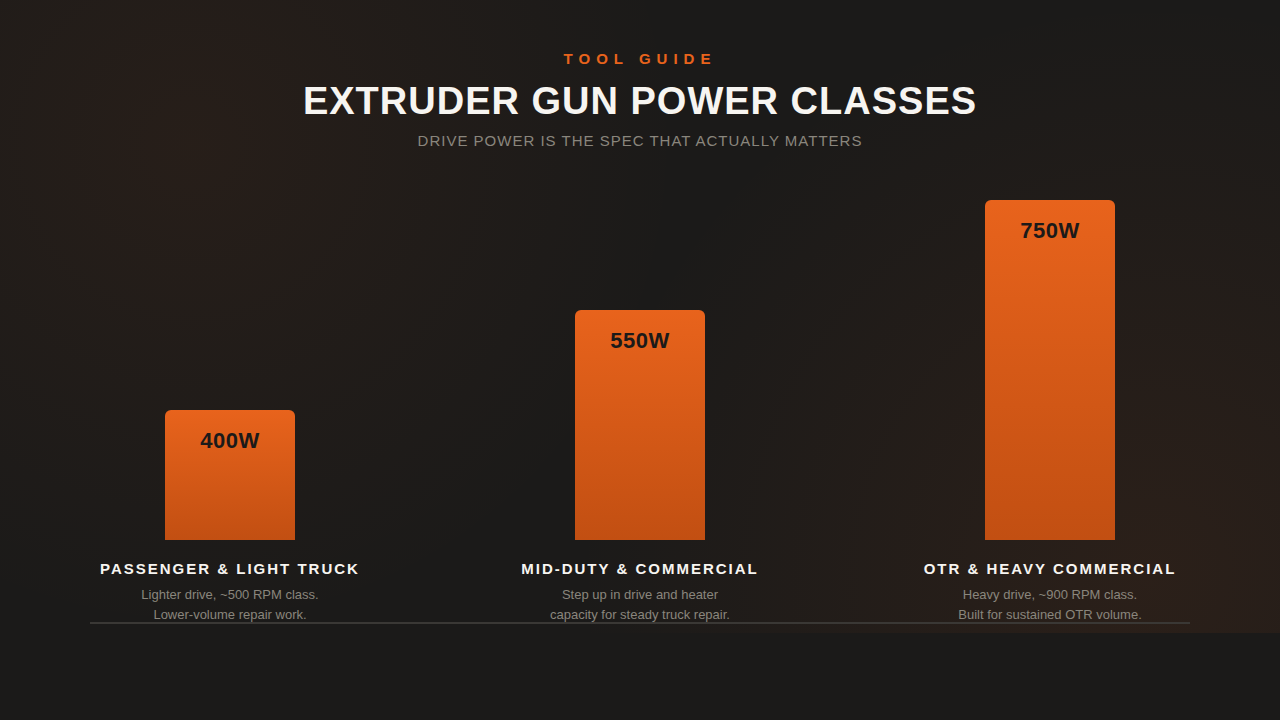
Extruder guns are sold in a few standard power tiers, and the tier is the spec that should drive your purchase — not the brand name on the barrel. Equipment catalogs from the major tire-repair suppliers consistently break the lineup into roughly three classes.
400W-class — passenger and light truck
The base tier, typically paired with a lighter-duty drive (around 500 RPM in the catalogs we checked). This is enough gun for passenger, light-truck, and lower-volume commercial repair work — smaller injuries, lighter rope volume, shorter duty cycles.
550W-class — mid-duty and commercial
A step up in both drive power and typically barrel heater capacity, aimed at shops doing steady commercial truck repair and retread prep where the 400W class starts to feel underpowered.
750W-class — OTR and heavy commercial
The heavy-duty tier — higher drive power (around 900 RPM in the same catalogs), built for off-the-road (OTR) tire repair and high-volume heavy commercial work, where injuries are bigger, rope volume needed is higher, and the gun runs for longer stretches without a break. Suppliers specifically market 750W-class guns (often built around Bosch or comparable industrial motors) as the OTR-rated option — a lighter gun run flat-out on OTR work will bog down or overheat rather than keep pace.
Buy for the heaviest tire class you actually repair. A shop that occasionally touches an OTR casing but is mostly passenger/light-truck doesn't need to default to the 750W tier — but a shop doing regular OTR or heavy commercial work that's still running a 400W gun is working against its own tools.
Beyond wattage: the other specs worth checking
- Barrel temperature control. Most guns on the market run a controllable barrel temperature range, commonly up to roughly 120°C. Some models offer a fixed low-temperature option — around 90°C is a common setting — specifically to hold rope rubber below premature-cure temperature between uses, which is what causes barrel clogging.
- Heater power vs. drive power. These are separate specs. Drive power (the motor pushing rope through the barrel) is what scales with the 400/550/750W tiers above. Heater power controls how fast and evenly the barrel brings rope up to extrusion temperature — check both, not just the headline wattage number.
- Drive type. Guns come as pneumatic (air-driven, common on shop floors already running compressed air for buffers and other tools) or electric/corded. Match it to what your shop is already set up to run.
- Cartridge and rope compatibility. Confirm the gun takes standard rubber cartridges or rope sizes you can actually source, not a proprietary format that locks you into one supplier.
- Weight and ergonomics. This is a hand tool used repeatedly through a shift. A gun in the 1–1.5 kg range with a comfortable grip matters more than it sounds once you're a few hours into a repair queue.
Maintenance: the step that determines gun lifespan
The most common way an extruder gun gets damaged isn't wear — it's rubber hardening inside the barrel between uses. Trade guidance from tire-repair equipment suppliers is consistent on the fix: run clean-out rope through the barrel at the end of a shift to flush residual rubber, and clear the gun before letting it sit, rather than leaving repair rope in a hot or cooling barrel overnight. A low-temperature barrel setting reduces how aggressively this happens between uses, but it doesn't replace the end-of-shift flush.
Head to head
| Tier | Drive power | Typical use | Watch for |
|---|---|---|---|
| 400W-class | Lighter drive (~500 RPM class) | Passenger & light truck repair | Underpowered for sustained commercial/OTR volume |
| 550W-class | Mid drive | Mid-duty & commercial truck repair | Good middle ground for mixed-fleet shops |
| 750W-class | Heavy drive (~900 RPM class) | OTR & heavy commercial repair | Overkill (cost, weight) for light-duty-only shops |
Which one should you buy?
Match the gun to the heaviest casing class you regularly touch, not your average job. If OTR or heavy commercial repair is even a regular part of the workload, the 750W-class gun pays for itself the first time a lighter gun would have bogged down mid-repair. If your shop is passenger and light-truck focused, the 400W-class is genuinely enough gun — there's no reliability or quality benefit to over-buying wattage you'll never use.
This guide is one piece of the full equipment buyer's guide, and if you're deciding what else your line needs, our curing chamber comparison covers the other major equipment decision most new shops face.
RELATED GUIDES
Looking for an extruder gun?
We supply extruder guns across the 400W, 550W, and 750W (OTR) classes, with transparent all-in Canadian pricing and delivery from our Ontario warehouse. Tell us the tire classes you repair and we'll spec the right gun for your shop.
Get an extruder gun quote →Ask About Extruder Guns
Send us your requirements and we'll get back to you within 24 hours with pricing and lead times — no obligation.